
Introduction
You have recently been seen by the Physiotherapist who have taught you various techniques to help manage your condition. This leaflet is designed to remind you of the correct technique and any personalised advice given during the session.
What is tennis elbow?
Tennis elbow, also known as lateral epicondylitis, is caused by a strain to tendons in the forearm where they join the bony part on the outside of your elbow. The tendons become inflamed when they are repeatedly stressed or aggravated. Any activity that involves gripping and twisting of the forearm can cause this type of strain. Most cases are not related to tennis or any type of exercise. Golfer’s elbow is a similar condition that affects the inside of the elbow joint near the funny bone.
Tennis elbow is a common and often lingering condition, which can become chronic if not treated correctly. It is important that you do your exercises only when you experience minimal or no pain at the level that you are performing. Regaining full strength and flexibility in the hand are forearm is vital, before you fully return to your previous activities.
Treatment Phase 1
During the acute stage of your injury you should:
- Rest – avoid any further overuse, but do not stop using your arm. You should continue your day to day activities but where possible avoid activities that aggravate the injury. Pain is the best guide to determine the appropriate type and level of activity, try to avoid aggravating your symptoms
- Ice – This is recommended if inflammation is present. Ice will help relieve pain and muscle spasms. Ensure the ice is wrapped in a towel, then place on the painful area for a maximum of 20 minutes at a time
- Wear – An epicondylitis clasp may be worn, if recommended by your Physiotherapist. This can be purchased from various outlets, physical stores or online. Your physiotherapist will show you a clasp and inform you how to use this appropriately
Phase 2 Stretching
Hold your arm in front of you with the elbow fully extended and the palm facing the floor. Slowly bend the wrist down until you feel a stretch. Hold the stretch for 20 seconds and repeat 2 to 3 times per day. Vigorous stretching is to be avoided. Do not continue into pain but you may feel some discomfort.
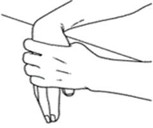
Strengthening
With the elbow bent and the wrist supported, perform the following exercises:
When completing the exercises, hold at the point of discomfort for 5 seconds and then relax.
Aim to repeat the exercises 10 times, 3 times per day. Aim to perform these 3 times a week on alternative days.
- Wrist Extension – Place a small weight in the hand with the palm facing down. Support the forearm at the edge of a table or on your knee so that only your hand can move. Raise your hand slowly as far as possible and lower slowly.
- Wrist Flexion – Place a small weight in the hand with the palm facing upwards. Support the forearm as above, bend the wrist up slowly as far as possible and lower slowly
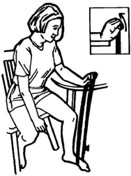
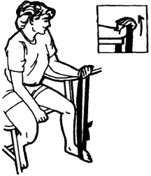
- Forearm Pronation / Supination – Grasp a rolling pin in the middle with the forearm supported. Rotate the hand slowly so the palm is facing down then return to the starting position. Then rotate the hand to the palm up position, slowly return to the starting position. To increase the resistance, move the hand further towards the end of the rolling pin
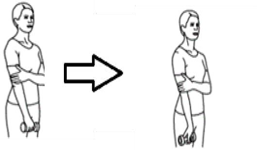
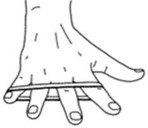
- Finger Extension – Place a rubber band around all finger tips. Spread the fingers against resistance. To increase the resistance add a second band
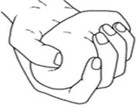
- Ball Squeeze – Place a rubber ball, or other squeezable object, in the palm of your hand and squeeze
Do not continue the exercises if painful, but you may feel some discomfort and /or aching after completing the exercises. When you can perform the exercises without pain, increase the load or the speed. Your Physiotherapist will guide you on this further. When your symptoms are resolved and you have regained full range of movement and strength, you may increase your level of activity to its normal level.
References
Tennis Elbow leaflet: https://www.csp.org.uk/public-patient/rehabilitation-exercises/tennis-elbow On The Chartered Society of Physiotherapy website (via www.csp.org.uk)
NHS website: https://www.nhs.uk/conditions/tennis-elbow/
Resources
Contact Details
Grimsby team
Musculoskeletal Team,
Physiotherapy Department,
Diana Princess of Wales Hospital
Telephone:

Scunthorpe team
Musculoskeletal Team,
Physiotherapy Department,
Scunthorpe General Hospital
Telephone:
Any Comments, Compliments, Concerns or Complaints
If you have any other concerns please talk to your nurse, therapist or doctor. Our Patient Advice and Liaison Service (PALS) is available on 03033 306518 (Grimsby, Scunthorpe and Goole). You can also contact [email protected]
As a Trust we value equality of access to our information and services, therefore alternative formats are available on request at [email protected]
NHS Website
NHS website is a health information service. The aim is to support the public to become active consumers of healthcare rather than passive recipients, and to help individuals, their family or carers to make more informed choices: https://www.nhs.uk/

Review information
Date of issue: November 2023
Review Period: November 2026