
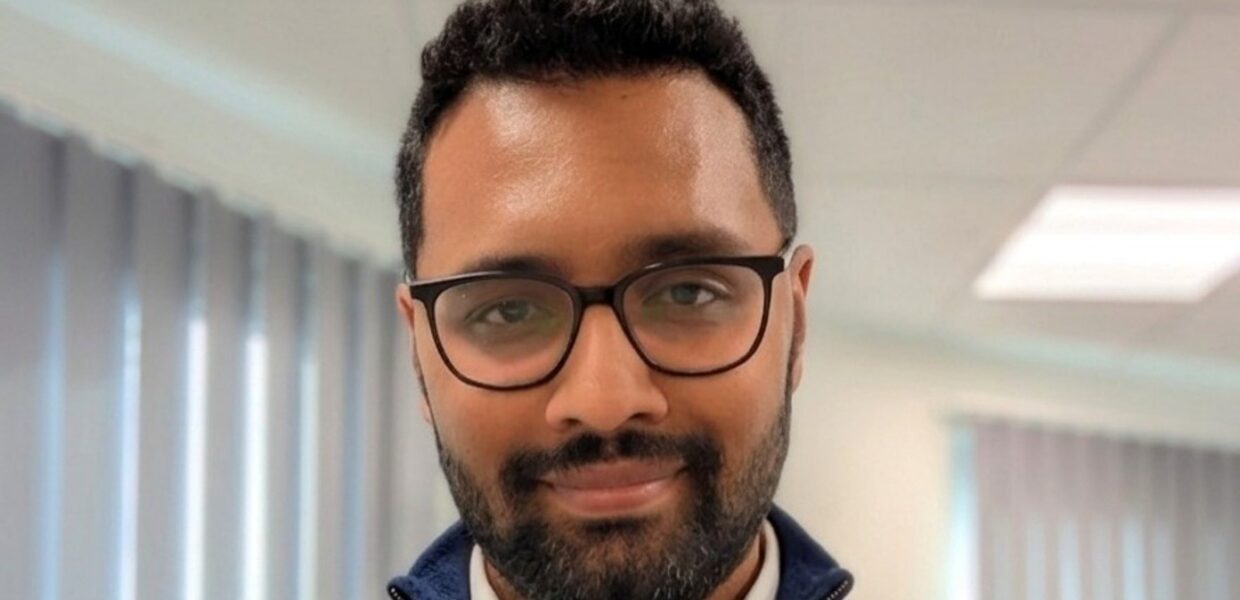
A trainee academic vascular surgeon has been shortlisted for a national Medipex innovation award for his work using artificial intelligence (AI) to improve outcomes for patients with complex surgical wounds, having previously won the award last year for a different project.
Mr Bharadhwaj Ravindhran, an academic vascular surgeon based in Hull, has been nominated in the “Using AI to improve patient services and/or safety” category for his project, Intuitive Decision Support for Surgical Wounds Healing by Secondary Intention (iSWHSI). The awards will take place on Wednesday 24 June.
Surgical wounds that heal by secondary intention or open surgical wounds represent a significant clinical challenge, often associated with prolonged recovery, repeated hospital visits, and substantial physical, emotional, and economic burden for patients and the NHS. This work builds on the internationally-recognised expertise of the Academic Vascular Surgical Unit at Hull in wound research, led by Professor Ian Chetter whose SWHSI research collaborative has made substantial contributions to wound care research, including a recent high‑impact publication of the multicentre randomised SWHSI‑2 trial in The Lancet.
The iSWHSI project aims to transform the management of these complex wounds through an AI‑powered, multimodal clinical decision support tool. Using routinely collected clinical data alongside safely anonymised wound images, the system generates personalised predictions for healing time and risk of adverse outcomes, supporting shared decision‑making and earlier, more effective interventions.
The model has been developed and internally validated using six years of real‑world NHS data, demonstrating strong predictive performance. Importantly, it incorporates explainable AI methodologies, ensuring that clinicians and patients can understand and trust the outputs, rather than relying on opaque “black‑box” predictions.
Mr Ravindhran said: “This work is about bringing clarity and foresight to a challenging clinical problem. By better understanding how wounds are likely to heal, we can personalise care, support shared decision‑making, manage patient expectations, reduce unnecessary hospital visits, and ultimately improve patient outcomes, while delivering value for the NHS.”
The next phase of the project will focus on prospective, evaluation across NHS settings to assess clinical utility and scalability. The anticipated benefits include improved patient experience, reduced healthcare inequalities, fewer unnecessary interventions, and significant cost and environmental savings.
The shortlisting reflects the growing international profile of AI‑driven innovation emerging from Mr Ravindhran and the vascular unit at Hull, with increasing recognition of its potential to transform patient care. Mr Ravindhran recently celebrated a win at the HSJ Digital Awards in the ‘Driving Prevention and Early Intervention through Digital’ category. This was for a project using AI to benefit patients with poor circulation.