A kidney transplant from a close friend has given dad-of-two Carl Dunderdale a new lease of life – and helped him reach heights he never expected.
Just months after receiving the life-changing gift, the Brigg resident entered the Transplant Games, won gold in the high jump and qualified for the chance to represent Great Britain at the World Transplant Games.
We caught up with him to find out more about his journey.
Back in 2019 Carl was juggling a busy family life with his wife and daughters, working offshore, keeping fit and enjoying time with his family and friends.
He had been feeling tired but put it down to the demands of everyday life. He had no reason to think there was anything seriously wrong.
When he turned 40, he was invited for a general health check with his GP. Blood tests showed that his cholesterol and blood pressure were higher than expected.
Having always considered himself fit and healthy, Carl asked to be referred to one of our renal consultants for further investigation. It was then that he discovered he had IgA nephropathy – also known as Berger’s disease – a kidney condition which is a form of chronic kidney disease and can potentially lead to kidney failure.
He said: “I didn’t know there was anything wrong. I didn’t really feel any symptoms to speak of, but tests found my kidney function was only 37%, Normal function is considered 90% or higher. At 37% I was considered stage 3b, with dialysis starting around 15%
“To me I had a normal life, normal day-to-day tiredness. It was a massive shock, I was devastated, it took a long time, but I came to terms with the diagnosis and realised it’s not the end of my life I just had to adjust to a different kind of future.”
Carl’s condition was monitored through regular appointments, and he was prescribed medicines, vitamins and iron supplements to help manage the condition.
However, in late 2023, tests showed that his kidney function had fallen to 22%, and by December it had dropped to 12%, and then 9%. Further intervention was needed and the appointments ramped up quickly into the start of 2024.
Carl said: “The trigger for starting dialysis is 15%, so when it fell to 12% appointments were ramped up with the dialysis and transplant teams to discuss my options”.
“I still felt okay. I was juggling life with kids, working, exercising and trying to maintain a social life. I knew there was something not quite right, but it didn’t feel that bad at the time. Because my kidney function decreased gradually over years, you just kind of adjust.
“Looking back, symptoms I did experience were nausea, itchy skin, severe nighttime cramps, and metallic tastes in my mouth – all of which are caused by all the toxins building up.”
Carl opted for manual Peritoneal Dialysis (PD), which uses the lining of the abdomen – the peritoneum – to filter waste and excess fluid from the blood.
This involves putting a catheter into the abdomen and introducing fluid into the cavity around the organs, before removing the fluid and waste along with it.
Carl said: “My employer at the time was great and allowed me to work from home during recovery and undertake the PD training. I started with two dialysis bags a day. You pick it up quickly, but it feels strange walking around with two litres of fluid in your abdomen. The fresh fluid goes in clear and after a ‘dwell period’ – usually a few hours – the fluid is drained, and it comes out a light urine like colour.”
Carl was soon able to return to work, although he had to come home slightly early each day to carry out his dialysis routine.
During this time, his brother and one of his oldest friends, Andrew Hensby – known as Rewy – offered to be tested as potential kidney donors.
And, after a battery of tests over a three to six month period, remarkably, they were both found to be a match.
Specialists felt that, given Carl’s condition, Rewy offered the best option for the transplant to go ahead.
For Carl, what followed was something for which he says he will always be deeply grateful.
And Rewy did not make that decision in isolation. His wife and son supported his determination from the very beginning, standing behind him as he went through the process of deciding to give up one of his own organs to help Carl.
“I am grateful every day,” Carl said. “My life is only as good as his kidney and his amazing generosity allows.”
The alternative was being placed on the Transplant list and waiting for a suitable kidney to become available.
The operation was scheduled to take place at St James’ Hospital, Leeds, in August 2024. Carl said: “We all went together. My brother took me and Rewy and, when we arrived, we parted ways, Rewy went to one ward and I went to another.
“He went down to Theatre at around 9am, and prior to heading into surgery myself we passed through the recovery room to see Rewy”.
“The surgery all went as smoothly as could be expected. My kidney – or should I say Rewy’s – started working immediately.
“As soon as they did the first bloods the next morning my kidney function was up to 20% and it’s kept going up and up since.
“My wife even asked the surgeon to take a picture of the Kidney before it went in, and he did – one for the family album!”
True to form, Carl was back at work by early November and soon began thinking about what he might be able to achieve next.
He had considered entering the Transplant Games in 2025 but felt it was perhaps too soon following his transplant. However, when the Games came around again this year, he decided to give it a try.
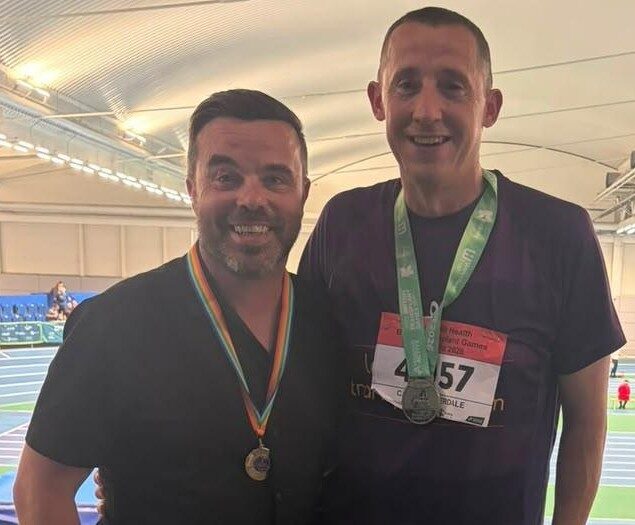
The Games took place in Sheffield, where Carl competed in snooker – taking bronze – and the high jump.
He laughed: “I have always played snooker and pool, but I don’t know why I went for the high jump. I’d not done it since I was at school and didn’t even have anywhere to practise, but then I won the gold medal!”
Not only that – his 1.45m jump was also enough to qualify him for the World Transplant Games in Belgium next summer, and he is now training for the opportunity to represent Great Britain!
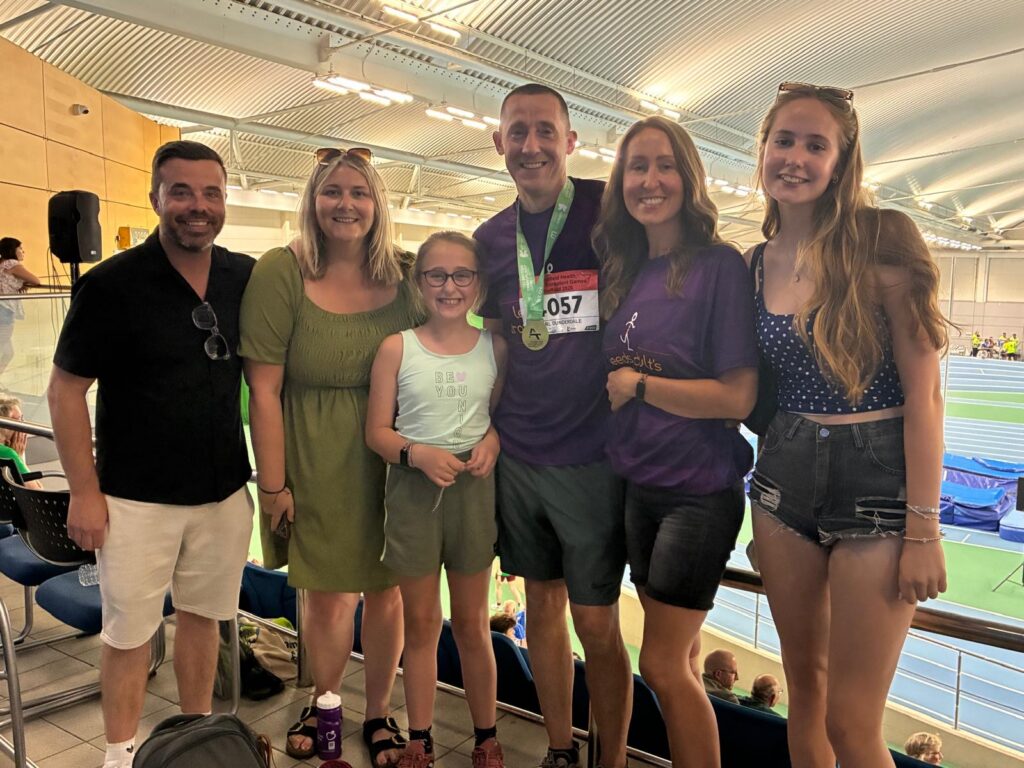
He said: “Taking part in the Games was a great experience. My family, Rewy, and his wife came to watch, and we met the Leeds Transplant team. Everyone was really friendly and helped us navigate our way around the games.
“Meeting other transplant recipients was one of the most rewarding parts of the Games. Hearing their stories and seeing what they had achieved was both inspiring and humbling.
“There was an immediate sense of shared understanding. Sometimes it can be difficult for people around you to truly appreciate what you’ve experienced because there are no obvious signs, but here there was no need for long explanations.
“It’s all too good to be true. Since the transplant, for the first time in years, the numbers were heading upwards, and keep improving – but I am acutely aware that a transplant is not a cure. It’s a treatment that requires strict control of diet, fluid intake and medication. I also have to live with the fact that the IGA Nephropathy might come back in the donor kidney.
“I am still being monitored with appointments every three months – and always will be. I remember one statement very vividly from my first consultation ‘you’ll be a kidney patient for life’.
“I still take a lot of medications not least immunosuppressants, which I need to take to stop my body rejecting the donor kidney.
“But this week my kidney function was 67% – the highest it’s ever been – and I’m looking forward to going back to the UK Transplant Games in Birmingham next year.
“Me and the family are particularly excited about the prospect of Rewy taking part in next year’s UK Transplant Games in Birmingham. After everything Rewy has done for it’ll be a proud moment to be there cheering him on and celebrating the gift that changed my life.”
You can find out more about organ donation, including how to register to become a donor, at Home – NHS Organ Donation and the work of our fantastic colleagues with the Leeds Transplant team here: Kidney (renal) transplantation – Leeds Teaching Hospitals NHS Trust
The Transplant Games are organised by Transplant Sport UK – an amazing national charity which promotes active recovery for transplant recipients and celebrates donors and their families. You can find out more about their work here: Transplant Active | Transplant Active