
Introduction
This information leaflet should provide most of the information you need about your Mallet Finger injury. In most cases you can be safely discharged home without further fracture clinic appointments. You can contact the fracture clinic directly using the numbers at the end of the leaflet to request further appointments if you have any problems. Other useful contact numbers can be found at the end of this leaflet.
What is it?
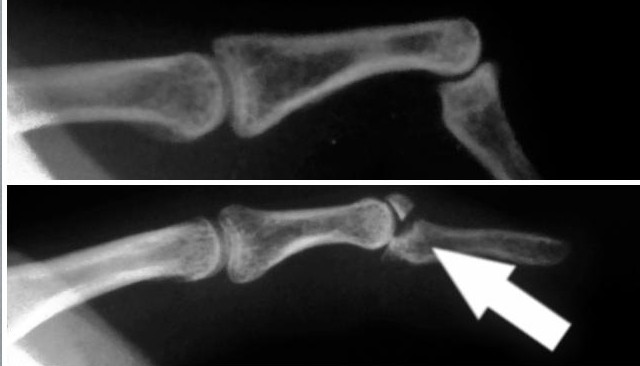
Mallet finger is a common injury that occurs when the outermost joint of a finger is injured. This may happen when an object strikes the tip of the finger, causing the tendon that straightens the finger to pull away from the bone (soft tissue mallet). Sometimes a small fragment of bone will come off with the tendon (bony mallet). As a result, the tip of the finger droops and you will find it difficult to straighten the finger at that joint.
How is it treated?
Treatment typically involves wearing a splint on the injured finger to keep it in a straight position for 6 weeks for a bony mallet injury and 8 weeks for a soft tissue mallet. This allows the tendon to heal properly.
The splint must be worn continuously during this period, even at night while sleeping. The splint can be removed for a short period to clean the hand but during this time, the finger must be kept straight by resting it on a flat surface. The splint should then be replaced immediately without bending the finger. Dry the finger properly before placing it back in the splint. Try to limit the amount of washing and aim to clean the finger a couple of times per week.
How long will it take to recover?
It takes about 8 weeks for a soft tissue mallet or 6 weeks for a bony mallet. After this, wear the splint at night or when the finger is at risk of injury such as repetitive activities or forceful gripping for the next 4 weeks. You can stop using the splint completely after about 10 to 12 weeks and resume your usual activities.
The finger may be stiff, painful, or swollen for a few months, but this should improve with normal use. You may be left with a slight loss of extension and a small bump on the finger, but you still be able to use it as normal. However, if you have persistent or worsening pain, or further loss of extension of the finger after removal of the splint, further treatment may be required. If there are persistent symptoms, please contact the fracture clinic.
Do excercises and physiotherpay help?
The joint that has been splinted may be stiff for a while after the splint had been removed and it can take up to a year for the movement to recover. You should move the middle joint of the finger regularly, around 10 times, 4 times per day. Do not remove the splint while doing the exercises.
When can I return to work and activity?
You can use the finger normally while using the splint which will prevent the other joints on the finger from becoming stiff. You can normally drive while using the splint. Normal sporting activities can be resumed after 12 weeks.
Do I need follow up?
Normally these injuries do not need to have follow-up, but you can contact the fracture clinic directly if you have any concerns. Please see the lists of contacts at the bottom of this leaflet.
Exercises
These exercises help improve mobility, strength and flexibility. Start slowly and stop if you feel pain. You should do these about 3 to 4 times per day.
Finger Extension Stretch: Remove the splint for this exercise. Hold your injured hand with the palm facing down resting on a table or flat surface. Use your other hand to gently lift the tip of the injured finger. Hold for 20 seconds and repeat 2 to 3 times.
Leave the splint in place for the following exercises.
Finger Bends: Bend your injured finger down to touch your palm. Straighten it back out. Repeat 5 times.
Towel Squeeze: Squeeze a rolled-up towel in your hand. Hold for 5 seconds and release. Repeat 10 times.
Finger Lifts: Place your hand flat on a table. Lift each finger one at a time, then lower it back down. Repeat 10 times.
Finger Taps: Tap the tip of your injured finger to the tip of your thumb. Repeat 10 times.
Contact
If you have any queries or concerns then please contact the hospital for further advice.
Between the hours of 9:00am and 4:30pm contact the fracture clinic on:
Scunthorpe: 03033 302164
Grimsby: 03033 306127
Goole: 03033 304036
Out of hours – then please contact the Emergency Department via switchboard:
Scunthorpe/Goole: 01724 282282
Grimsby: 01472 874111
Any Comments, Compliments, Concerns or Complaints
If you have any other concerns please talk to your nurse, therapist or doctor. Our Patient Advice and Liaison Service (PALS) is available on 03033 306518 (Grimsby, Scunthorpe and Goole). You can also contact [email protected]
As a Trust we value equality of access to our information and services, therefore alternative formats are available on request at [email protected]
NHS Website
NHS website is a health information service. The aim is to support the public to become active consumers of healthcare rather than passive recipients, and to help individuals, their family or carers to make more informed choices: https://www.nhs.uk/

Review information
Date of Issue: December 2025
Review period: December 2027