
Introduction
This information leaflet should provide most of the information you need about your child’s Clavicle (collar bone) Fracture.
Most children can go home safely without needing further Fracture Clinic visits. If you have concerns or need another appointment, call the fracture clinic using the contact numbers at the end of the leaflet.
What is it?
Clavicle fractures are a common injury in children. It is a break in the bone often caused by either a fall onto an outstretched hand or from a direct blow. The clavicle, also known as the collarbone, connects the arm to the body and is located between the shoulder blade and the ribcage. In children, these fractures normally heal well without surgery.
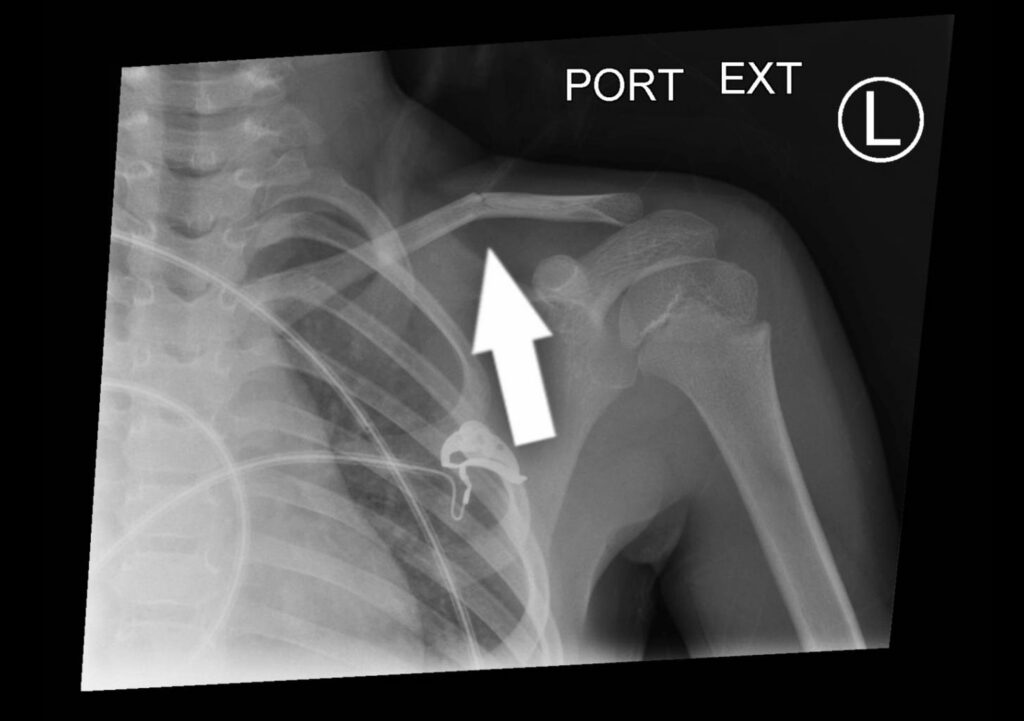
How is it treated?
Treatment usually involves pain relief and a sling to support and immobilise the arm. This can normally be removed once the pain has settled, which can take 2 to 3 weeks. Your child may be more comfortable sleeping upright while wearing the sling for a while after the injury.
Some children refuse to wear the sling, and this is not normally a problem, as they will only move the arm as much as their pain allows.
Does my child need pain relief?
Appropriate doses of simple analgesia such as paracetamol and ibuprofen can be used for a short period of time. But as children heal quickly, this is not normally needed after a week or two.
How long will it take to recover?
In most cases, clavicle fractures in children heal without surgery within 3 to 6 weeks but may continue to be sore for a few weeks after the injury. Often there is a lump at the fracture site that is normal for healing bone. This usually resolves completely in younger children, but a small bump or deformity can remain in children over the age of 10. This will not affect your child’s arm or shoulder movement the future.
Do exercises and physiotherapy help?
Children do not need physiotherapy after this type of injury, and they will start moving the arm normally once the pain has settled.
When can my child return to school and normal activities?
Children can return to school and normal activity as soon as their pain allows. The school should be advised to keep your child indoors during playtimes in the first couple of weeks. Rough play or contact sport should be avoided until the fracture is fully healed at around 6 weeks.
Does my child need follow-up?
Normally children heal without intervention and do not need further follow-up or X-Rays. You can contact the fracture clinic if you are worried, for example:
- If your child is still in excessive pain after having pain relief
- If your child complains of constant pins and needles in the affected arm
- Your child is experiencing shortness of breath
- Your child’s skin becomes tented and white (as though the bone ends are trying to poke through) or develops an open wound on the skin at the fracture site.
What if I need more information or help?
You can contact the fracture clinic directly if you have any concerns. If you have been given a Patient Initiated Follow-Up (PIFU), you can contact the team to request further appointments.
Contact
If you have any queries or concerns then please contact the hospital for further advice.
Between the hours of 9:00am and 4:30pm contact the fracture clinic on:
Scunthorpe: 03033 302164
Grimsby: 03033 306127
Goole: 03033 304036
Out of hours – then please contact the Emergency Department via switchboard:
Scunthorpe/Goole: 01724 282282
Grimsby: 01472 874111
Any Comments, Compliments, Concerns or Complaints
If you have any other concerns please talk to your nurse, therapist or doctor. Our Patient Advice and Liaison Service (PALS) is available on 03033 306518 (Grimsby, Scunthorpe and Goole). You can also contact [email protected]
As a Trust we value equality of access to our information and services, therefore alternative formats are available on request at [email protected]
NHS Website
NHS website is a health information service. The aim is to support the public to become active consumers of healthcare rather than passive recipients, and to help individuals, their family or carers to make more informed choices: https://www.nhs.uk/

Review information
Date of Issue: December 2025
Review period: December 2027