Simple ideas to help you now – this pack aims to provide strategies, advice and activities to support parents/carers to help develop a child’s speech sounds.
We recommend that these activities are done at set times during the day (e.g. after tea) as well as throughout the child’s day. These ideas can also be shared with the child’s school/nursery.
How do children learn sounds?
From the moment babies are born, they look at our faces and start to babble. They use early lip sounds (such as B or M) and from around 12-18 months, children start to use first words, such as ‘mama’ or ‘baba’, which include these first sounds.
If children are late to start talking, this can impact on their speech sounds developing. If children have difficulty with their hearing, such as glue ear, this may also impact on their sounds. Sometimes, there is no known reason why children have difficulty developing their speech sounds.
Children don’t learn to say words clearly straight away. We don’t expect you to be able to understand the child 100% of the time. Remember, the child is learning new skills all at the same time.
| Age Range | Typical development of speech sounds |
| Under 2 | We do not expect 2-year-olds to speak clearly. Model words to the child and engage in ‘babble play’ (copying your child’s sounds) |
| 2-3 | P B M D N H T K G W NG Y |
| 3-4 | F S V Z |
| 4-5 | L J CH SH |
| 5-6 + | R ZH TH (as in ‘feather’) |
| 6 + | TH (as in ‘thing’) |
How do we make sounds?
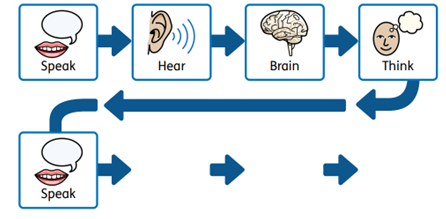
- Someone will say something and the message goes into your brain
- Your brain must recognize what has been said and form an answer
- Your brain must figure out the order of the words and which sounds it needs
- The brain sends the message to your mouth
- Your mouth has different things to create the sounds;
- Your lips
- Your tongue
- Your teeth
- The roof of your mouth
Here are some instructions about how to make some consonant letter sounds:
P – Put your lips together, make a quiet sound
B – Put your lips together, make a loud sound
M – put your lips together and hum
W – make your lips round and release
T – put your tongue on the ridgey bit behind your teeth and tap it softly
D – put your tongue on the ridgey bit behind your teeth and make a loud tap
N – put your tongue on the ridgey bit behind your teeth. Keep it there and hum
K – lift the back of your tongue up to the top of your mouth
G – lift the back of your tongue up to the top of your mouth and make a loud sound.
F – put your top teeth on your bottom lip and blow
S – make a big smile, put your tongue behind your teeth and make a hissy sound
SH – round your lips, your tongue will touch your teeth at the sides
L – put your tongue on the ridgey bit behind your teeth and flop it down.
It’s very complex to learn new sounds, so give the child time to listen and practice. Be patient and positive.

Communication Buddy Quiz (for parents)
Try our quick quiz to check you are the best Communication Buddy you can be for your child.
- I always/sometimes/never talk to my child slowly and clearly
- I always/sometimes/never give my child time to respond to my questions.
- I always/sometimes/never model words to my child that they find tricky to say.
- I always/sometimes/never talk to my child about what we can see on the way to/from school, or whilst waiting in a queue.
- I always/sometimes/never look at books together with my child each day.
Activities by age
Children aged three to four years old
Some sound errors are typical for children who are aged three to four years and should not be a cause for concern. If a child is still making errors that are typical of a younger child then consider making a referral to your local Speech and Language Therapy Team.
Can be heard until four years: Saying long sounds such as ‘s’ as shorter sounds such as ‘t’ e.g. “sun” is said as “tun”, fan is said as ‘ban’.
Can be heard until five years: Sounds ‘ch’ and ‘j’ (as in cheese and jam) are said as ‘t’ and ‘d’ sounds.
Can be heard until six years: Groups of sounds containing ‘s’ are reduced to just one sound, ‘snail’ said as ‘sail’, ‘spider’ said as ‘pider’.
Can be heard until seven to eight years:Sounds r and l are said as w e.g. red is said as ‘wed’, look is said as ‘wook’.
Can be heard until seven to eight years however also very common error in many local accents Th sound is said as ‘f’ e.g. thumb is said as ‘fum,
Children aged three to four should be able to:
- Understand instructions well
- Should be able to engage in an activity with an adult for at least 5-10 minutes
- Talk in longer sentences of four to six words, e.g. ‘I can see a cat’
If you have answered YES to the above, see activities and strategies below.
If you have answered NO to the above, consider trying some of the activities for children aged two to three years.
Activities for three to four year olds
Rhyming

Activity
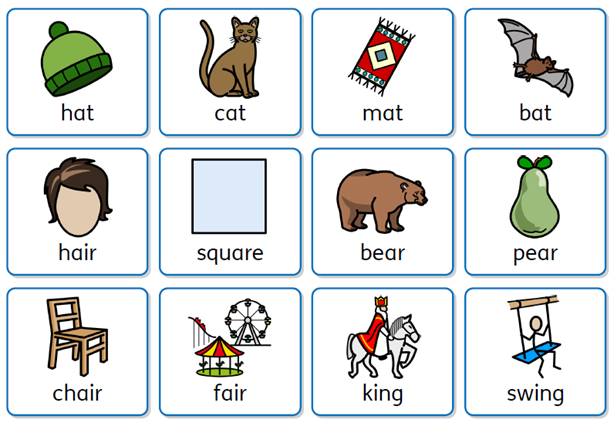
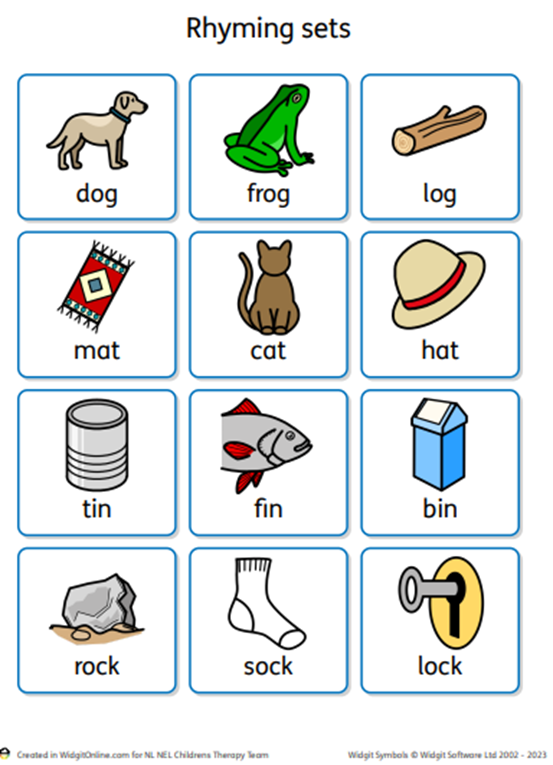
Use the Picture Resource Set 4 Rhyming Picture Sets to play match the rhyme games. Hide the pictures in a bag or around the room and take it in turns to find a word and match it to another rhyming word.
Read rhyming books together that contain lots of rhyming words.
e.g. Chocolate Mousse for Greedy Goose, The Gruffalo, Room on the Broom, Duck in a Truck, emphasising and repeating the rhyming words as you read.
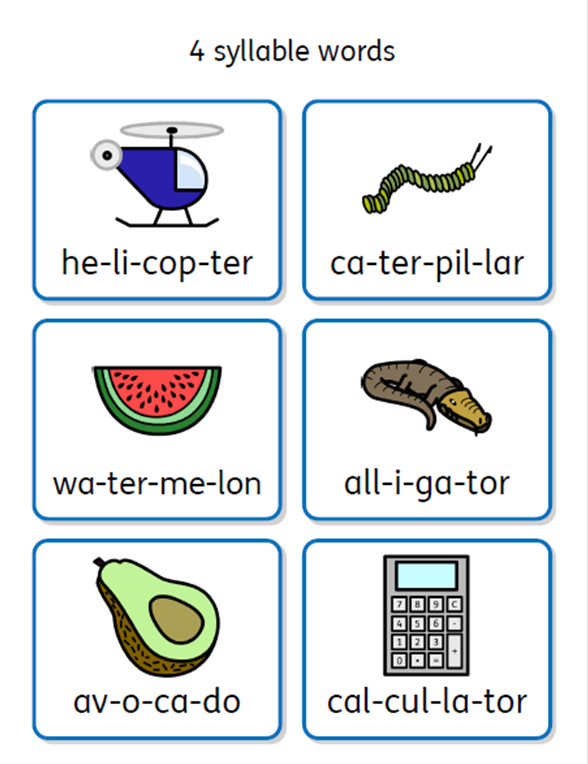
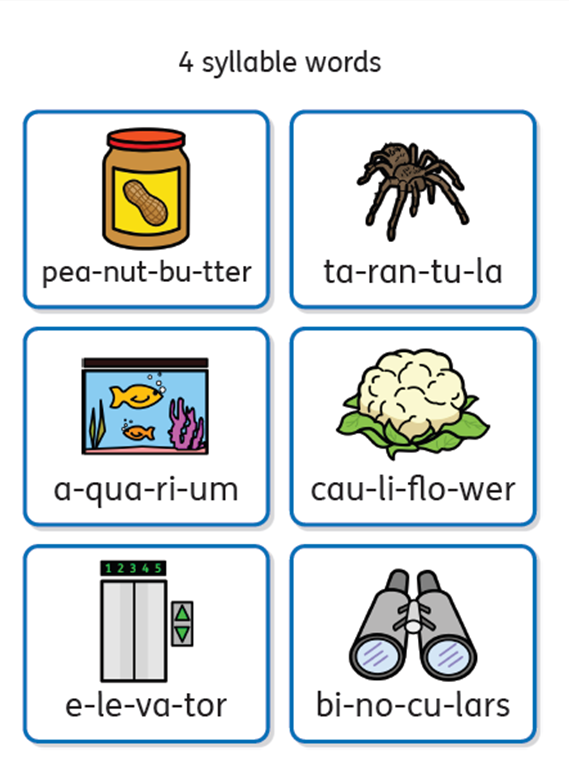
Syllable clapping
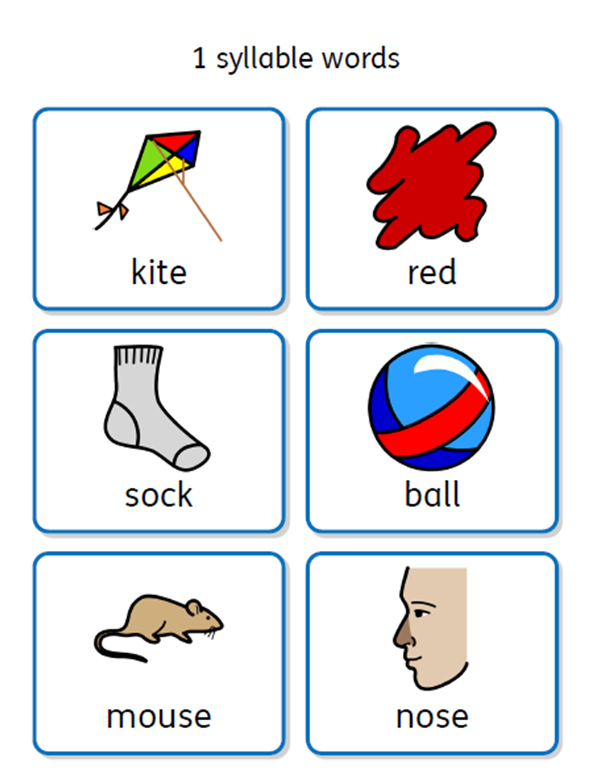
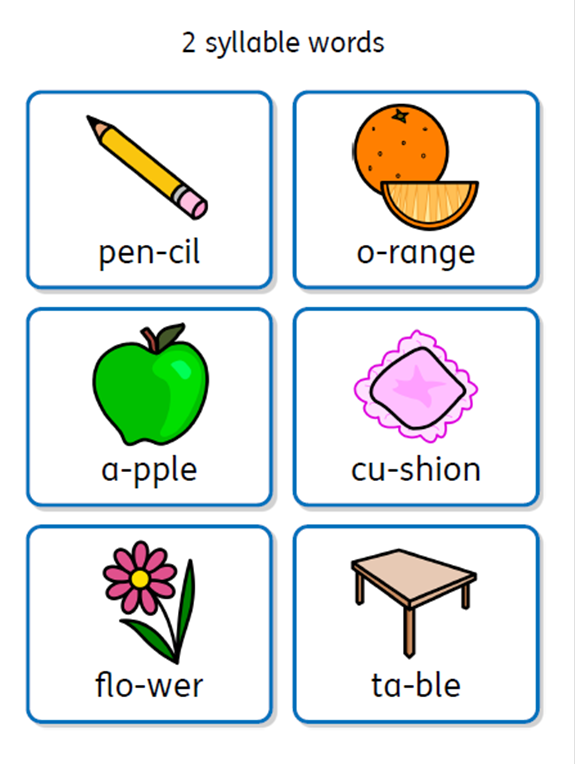
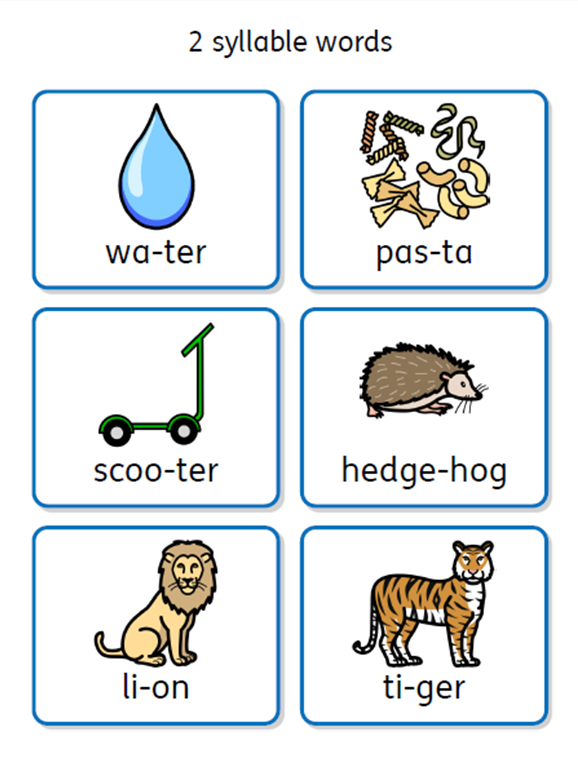
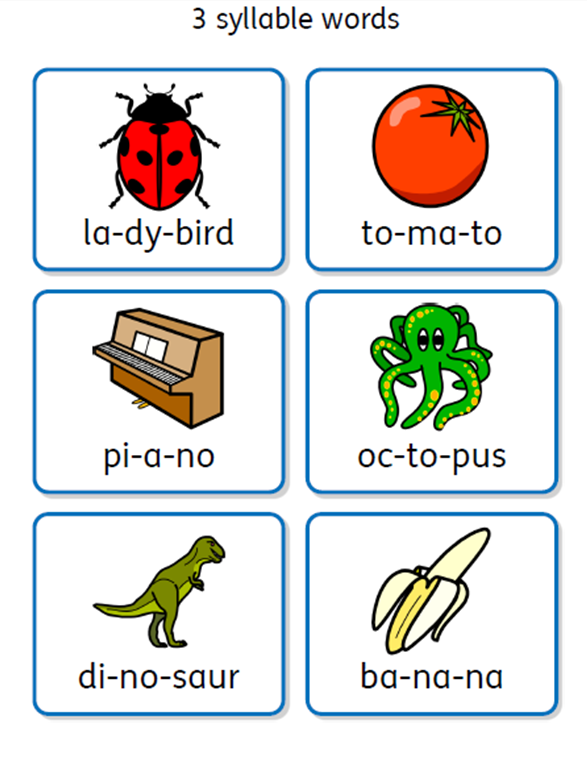
Syllables are the parts that make up a word – for example “apple” has 2 syllables “a-pple” and “crocodile” has 3 syllables “cro-co-dile”. Some children can find it difficult to listen to all of the parts of a word and may miss out parts that are smaller or less obvious. So “crocodile” may become “crodile” Clapping along with these syllables can help children to listen to all of the sounds in the word.
Use Picture Resource Set 5 Syllable PIctures
The child may try and copy the clapping, or you can hold their hands to help them if they find this difficult. Try clapping words with 2 syllables before you move on to 3 syllables.
You can also practice syllable clapping during everyday activities, for example clapping the syllables in your names, or everyday items.
Listening to Sounds
Children also need to be able to hear the differences between speech sounds. The below activities support children to begin to listen to these differences.
Activity
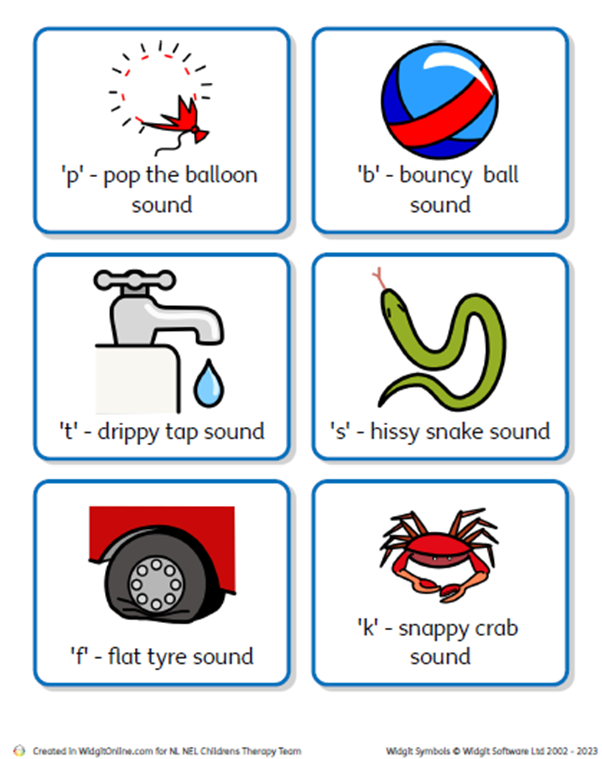
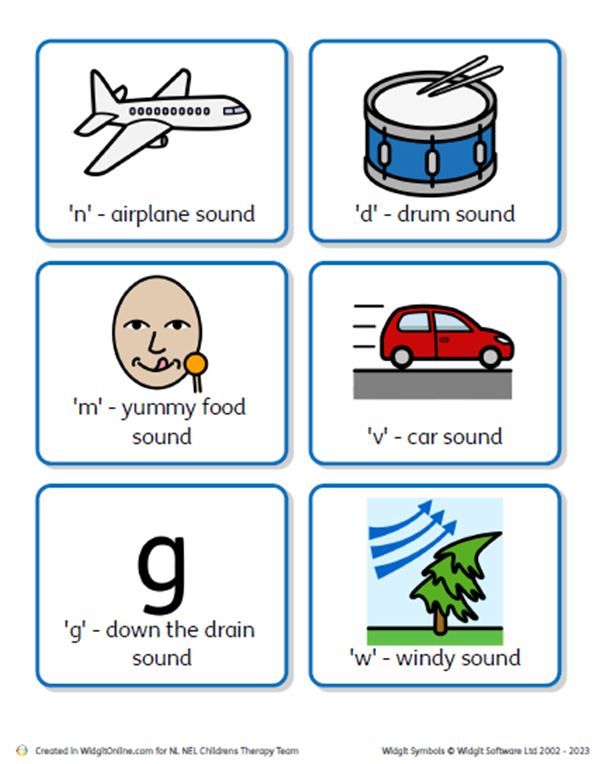
Use Picture Resource Set 6 Sound Picture Cards to help the child to listen and find different sounds e.g. p for pop, b for bouncy ball. Say the sounds and match them to the pictures.
Once the child is familiar with the sounds see if they can find the one you are saying e.g. Find the one that says ‘mmm’. Be careful to make the letter sound and not say the name of the letter e.g. m = mmmm.
Don’t push them to make the sound for themselves as it might be too tricky for them, but if they try give them lots of praise!
If the child is enjoying the sound cards try the following activities:
- Play hide and seek with the cards by hiding them around the lounge or in the garden.
- Play posting games where you post the sound card in a home-made posting box (make a box out of a cereal packet and decorate it with colouring pens or stickers).
- Attach the sound cards to toy skittles and say the sounds as you knock them over.
Listen to sounds in words throughout the day
There are lots of opportunities to talk about sounds in words as you go through your day, e.g.
Bath time – you could say “fish, that starts with a ‘f’ sound”, bubbles that starts with a ‘b’ sound”
Getting dressed – you could say “sock, that starts with a ‘s’ sound”, “hat, that starts with a ‘h’ sound”
Walking to school – “car, that starts with a ‘ck’ sound”, “dog, that starts with a ‘d’ sound”
Out shopping – you could say “look, bananas, that starts with a ‘b’ sound”
Children aged four to five years old
Common speech sound errors for children four to five years
Some sound errors are typical for children who are aged four to five years and should not be a cause for concern. If they are still making errors that are typical of a younger child then consider making a referral to your local Speech and Language Therapy Team.
Children aged four to five should be able to:
- Understand longer instructions including those containing sequencing words (‘first… after… last’)
- Attention now two channelled (understands verbal instructions related to the task without need to pause to look at speaker)
- Talk in longer sentences that are well formed, (e.g. ‘I played with Jack at lunch time’)
If you have answered YES to the above, see strategies and activities below.
Model the words for your child
If the child makes an error, simply repeat the word back to them and emphasise your sounds e.g. child says: Daddy there’s a tat. Daddy says: yes, a cat.
When your child is more confident with their speech sounds then offer them a choice if they make an error e.g. ‘is it a dock or a sock’?
Make deliberate errors in your own speech. For example say “I’m putting my docks on” and see if your child can correct you.
Rhyming
Activity
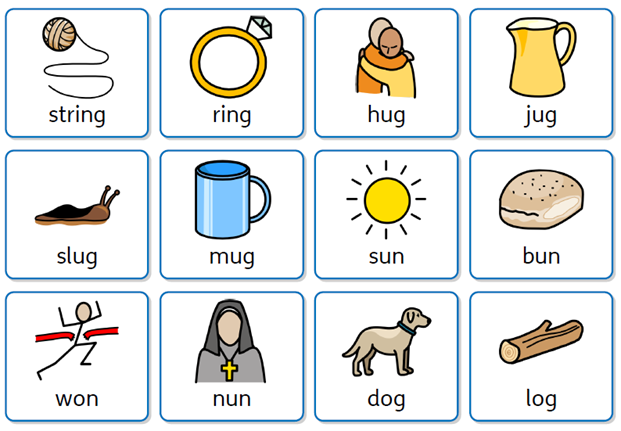
Play a matching game with pairs of rhyming words. Use Picture Resource Set 7 Rhyming Word Pairs
You will find pictures in our resource section below to help you play this game.
Look at the pictures with the child and name them.
Put all the pictures upside down on the table, take it in turns to turn two cards the right way up, if they sound the same/rhyme you win them, if they do not sound the same/rhyme turn them back upside down.
e.g. Bun and sun – “Yes they rhyme” – Chair and ring – “No they don’t rhyme”
The winner is the one who has most pairs at the end of the game.
Clapping our syllables
Syllables are the parts that make up a word – for example “apple” has 2 syllables “a-pple” and “crocodile” has 3 syllables “cro-co-dile”. Some children can find it difficult to listen to all of the parts of a word and may miss out parts that are smaller or less obvious. So “crocodile” may become “crodile” Clapping along with these syllables can help children to listen to all of the sounds in the word.
Use Picture Resource Set 5 Syllable Pictures – Clap out words with one, two or three syllables. Encourage the child to clap independently, but clap along with them if needed. You can also try banging out the syllables on a toy drum or pan.
Listening to Sounds
Children also need to be able to hear the differences between speech sounds. The below activities support children to begin to listen to these differences.
Activity
Use Picture Resource Set 6 Sound Picture Cards to help your child to listen and find different consonant sounds e.g. p for pop, b for bouncy ball. Say the sounds and match them to the pictures.
Once they are familiar with the sounds see if they can find the one you are saying e.g. Find the one that says ‘mmm’. Be careful to make the letter sound and not say the name of the letter e.g. m = mmmm.
Don’t push them to make the sound for themselves as it might be too tricky for them, but if they try give them lots of praise!
If the child is enjoying the sound cards try the following activities:
- Play hide and seek with the cards by hiding them around the lounge or in the garden.
- Play posting games where you post the sound card in a home-made posting box (make a box out of a cereal packet and decorate it with colouring pens or stickers).
- Attach the sound cards to toy skittles and say the sounds as you knock them over.
Listening to sounds in words
The child may be able to begin to listen and find the sound that is used at the beginning of everyday words e.g. cat begins with ‘c’.
Use Resource Set 6 Sound Picture Cards to help your child find the correct beginning sound for some easy words in the list below:
Pie Bear Two Door Car Go Four Sea Van Me No
Children aged five to six years old
Common speech sound errors
Some sound errors are typical for children who are aged five to sixyears and should not be a cause for concern. If they are still making errors that are typical of a younger child then consider making a referral to your local Speech and Language Therapy Team.
- Can be heard until six years: Groups of sounds containing ‘s’ are reduced to just one sound, ‘snail’ said as ‘sail’, ‘spider’ said as ‘pider’.
- Can be heard until seven to eight years: Sounds r and l are said as w e.g. red is said as ‘wed’, look is said as ‘wook’.
- Can be heard until seven to eight years however also very common error in many local accents: Th sound is said as ‘f’ e.g. thumb is said as ‘fum
Children aged five to six should be able to:
- Understand and follow a simple story without needing pictures to support
- Pay attention and listen well. They can focus on relevant and necessary information.
- Enjoy telling you about their day and what they have been doing
If you have answered yes to the above, see strategies and activities below.
It is IMPORTANT to note that children aged 5-6 years will be more aware of their speech sound errors. This could impact on their confidence in speaking and other children may comment on their errors too. TAKE CARE to build the child’s confidence in communicating, focus on activities they are good at and avoid being critical or negative about their speech.
REMEMBER they are not lazy, learning to say speech sounds correctly can be a difficult process for some children.
Rhyming
Read rhyming stories together and leave a gap for the child to finish the rhyme e.g. The fat cat sat on the ____.
Make up your own silly rhymes. It can be fun to think of a word that rhymes with your name e.g. Emily – Bemily – Wemily.
Think of sets of words that rhyme together e.g. dog/log/frog, hat/mat/cat.
Activity
Use the Picture Resource Set 4 Rhyming Picture Sets to play a game where your child sorts out which words rhyme together.
Making your own speech errors
An adult can make a deliberate error in their own speech for the child to spot and correct the adult e.g. adult says ‘here’s my tar’ (meaning ‘car’), child says ‘no you said it wrong’.
Make deliberate errors whilst reading their favourite story e.g. Here is Goldilocks and the 3 pears.
If the child is more confident with their speech sounds then offer them a choice if they make an error e.g. is it a dock or a sock. Be patient with them if they cannot easily correct their error.
Listening for sounds games
These games help your child to be more aware of which sounds are needed to say words and give them practice at saying the sounds if they are happy to join in. Its important to hear which sounds are needed in order to use and say them.
- Play I spy and practice looking around for items that begin with a particular letter sound e.g. I spy with my little eye something beginning with p (paper, pen, pie, pocket etc)
- Play the memory game ‘Granny went to market and bought…’ Take it in turns to add something to the list that Granny bought but you have remember the items that have been chosen before by the other players. Practice remembering items that begin with the same sound e.g. Granny went to market and bought, soup, socks, sand, salt etc.
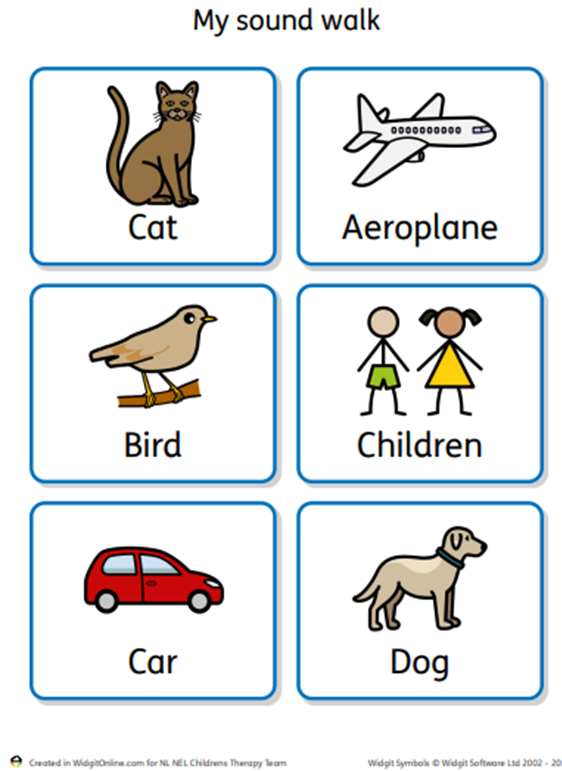
- Go on a jungle or nature walk and when you spot the animals or items then talk about which sound is at the start or the end of the word e.g. leaf – begins with ‘l’ and ends with ‘f’, ant – begins with ‘a’ and ends with ‘t’.
- Play a hunt the object game where you have to find an item that begins or ends with a certain sound e.g. find an item that begins with ‘c/k’ – key/cushion/cat. You could then play a sorting game to sort out which items begin with the same sound.
Clapping out syllables
Practice clapping out the number of syllables in a word. Use a mix of words that have 1 syllable (boat), 2 syllables (tractor), 3 syllables (aeroplane) and 4 syllables (helicopter). Clap out the syllables, bang them on a toy drum (or pan) or count them on your fingers.
Use Picture Resource Set 5 Syllable Pictures to help you find words to clap out. However you can also think of a category e.g. animals, transport, food, colours, toys, names.
Look in a mirror
This activity is helpful if the child is not sure how to make certain sounds with their mouth. Talk about the parts of your mouth including lips, tongue, teeth, palate (roof of mouth) and which parts of your mouth you need to make a sound e.g. f – your top teeth press on your bottom lip.
Keep this activity fun and do not pressure them if they are struggling to make the sound. Consider linking the sound to an animal or a pretend monster e.g. f can be the bunny sound.
Picture resources
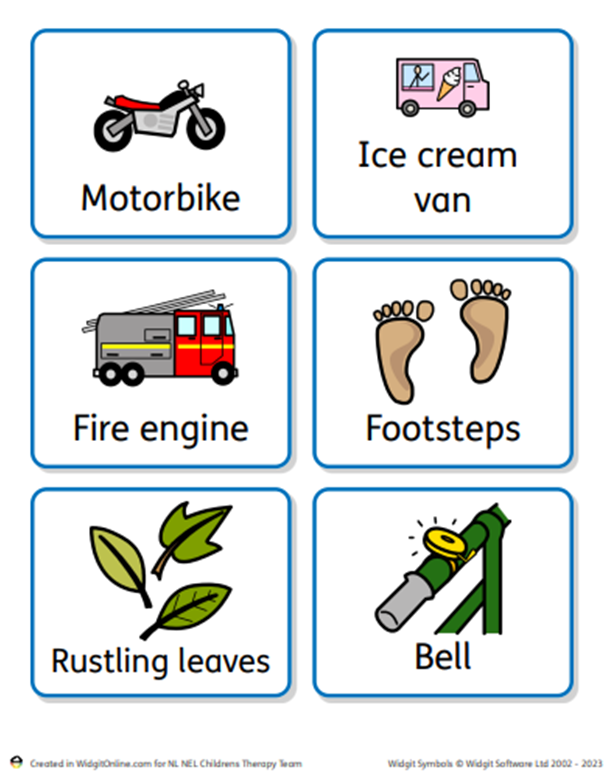
Picture Resource Set 1 Sound Walk Pictures
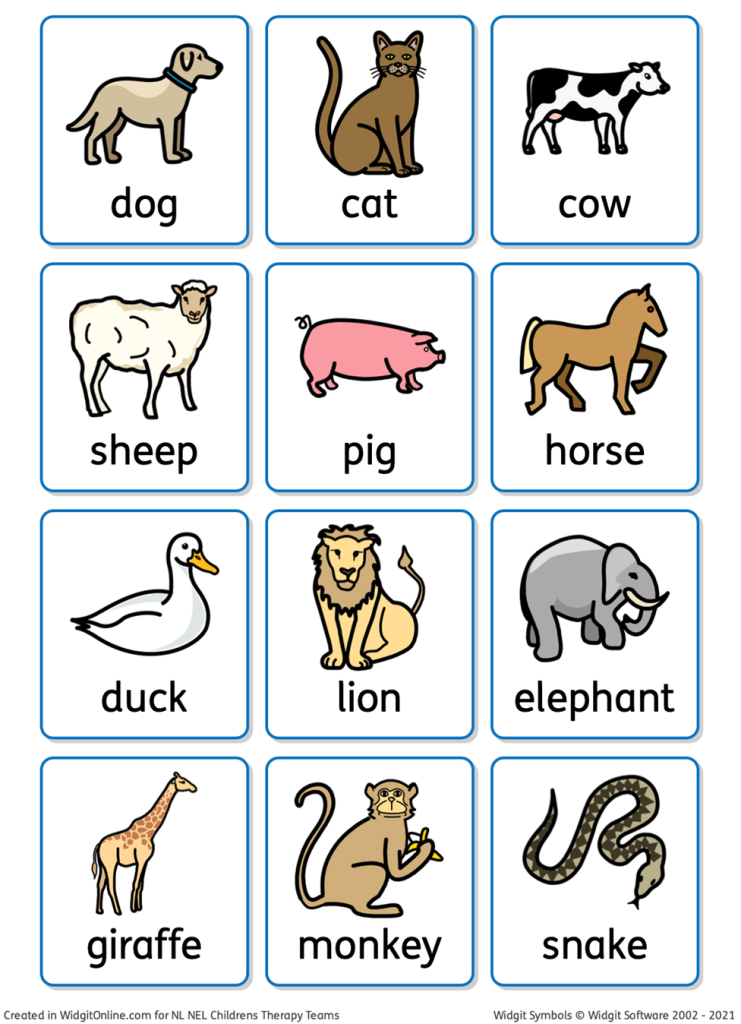
Picture Resource Set 2 Animal Pictures
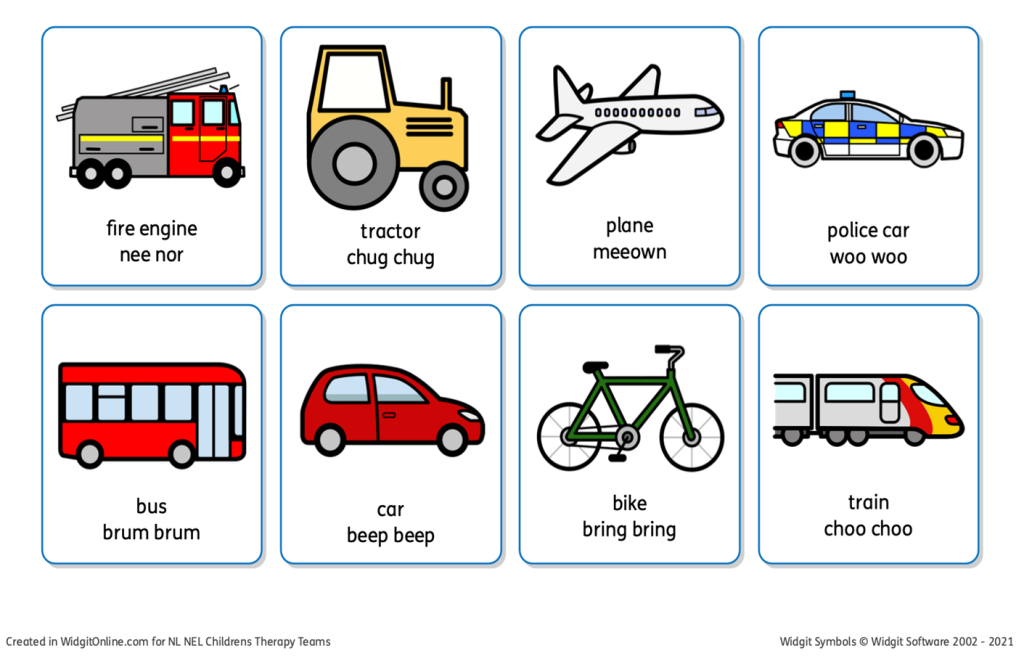
Picture Resource Set 3 Transport Pictures
Picture Resource Set 4 Rhyming Picture Sets
Picture Resource Set 5 Syllable Pictures
Picture Resource Set 6 Sound Picture Cards
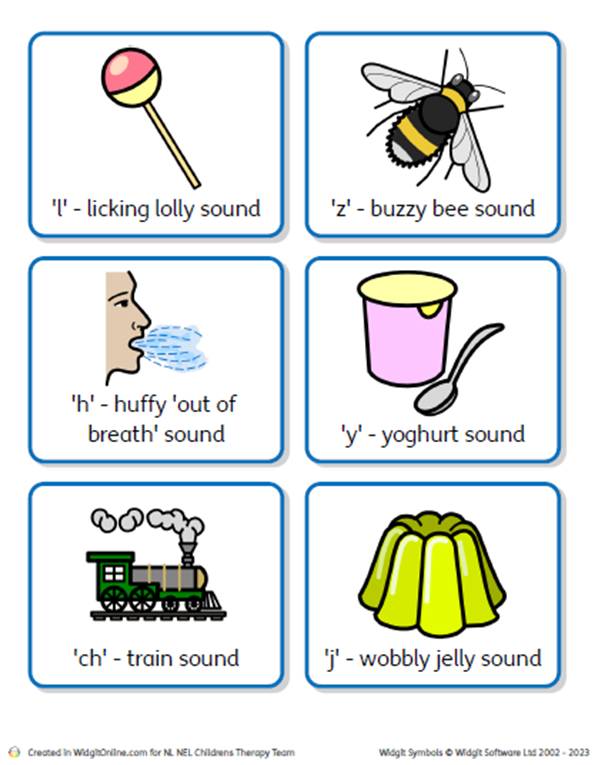
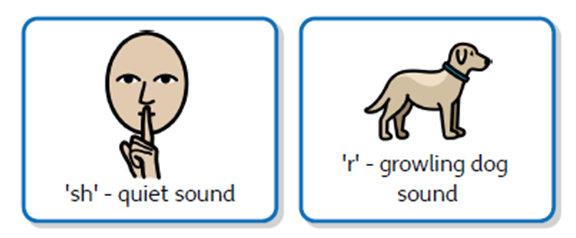
Picture Resource Set 7 Rhyming Picture Pairs