
Introduction
This information leaflet should provide most of the information you need about your Weber A Ankle Fracture. Most people can go home safely without needing further Fracture Clinic visits. If you have concerns or need another appointment, call the fracture clinic using the contact numbers at the end of the leaflet.
What is it?
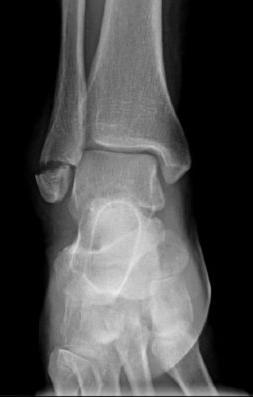
A Weber A ankle fracture is a break at the tip of fibula, the smaller of the two bones in the lower leg. This type of fracture is considered stable and often heals well without the need for surgery.
How is it treated?
These fractures can be managed with a tubular compression bandage or an ankle stirrup to support the ankle as it heals and using crutches if necessary for comfort and mobility. You do not normally need a cast to treat this type of fracture. Full weight-bearing is usually allowed as tolerated by pain levels.
Do I need pain relief?
You can use simple over the counter analgesia such as paracetamol. In the first 48 hours you can also use the RICE treatment to reduce pain and swelling:
- Rest: You can move about but resting the leg can help reduce the pain and swelling.
- Ice: Apply ice packs to reduce swelling. Don’t apply the ice directly to the skin. Place the ice in a plastic bag and wrap in a towel.
- Compression: Use an elastic bandage, such as tubigrip, if you have any.
- Elevation: When sitting or lying keep the leg raised on a pillow to reduce swelling.
How long will it take to recover?
You may experience swelling for up to 12 months following the injury. Although most of these fractures heal well, a small number may not unite meaning that you may have persistent pain in the ankle. Should you have any concerns, please contact the fracture clinic.
Do exercises and physiotherapy help?
Yes, exercises do help to regain strength, range of movement and stability. You can commence these as soon as possible. You will find a list of exercises to do at home at the end of this leaflet.
When can I return to work and normal activities?
Driving
You can start driving once you:
- are no longer using the splint
- can walk comfortably
- can perform an emergency stop
Work
This depends on the type of work that you do:
- Office based: You may be able to return to work once the pain has settled.
- Physical activity: May take longer especially if you spend a lot of time on your feet or do heavy physical work.
Sport
You can usually start again once you have a full range of movement and can walk briskly without pain. Returning to activity and sports should be a gradual process. Contact sports and activities that put a strain on the ankle may be difficult for at least 8 weeks.
Do I need follow-up?
You do not normally need any follow-up but if you have any concerns then you can contact the fracture clinic on the numbers shown at the end of this leaflet.
Exercises
Start these exercises gently and gradually and build up as pain allows. You should aim to do these exercises 3 to 4 times per day.
Ankle Pumps: Sit or lie down with your leg straight. Move your foot up and down slowly. Repeat 10 to 15 times.
Ankle Circles: Sit or lie down with your leg elevated. Rotate your foot in circular motions. Complete 10 circles in each direction.
Towel Stretch: Sit with your leg extended. Wrap a towel around the ball of your foot. Gently pull the towel towards you for a stretch. Hold for 15 to 20 seconds and repeat 3 times.
Heel Raises: Stand with support from a chair or wall. Slowly rise onto your toes and lower back down. Repeat 10 to 15 times.
Calf Stretch: Stand facing a wall with your hands on it. Step back with the injured leg, keeping it straight. Press your heel down and hold for 20 to 30 seconds. Repeat 3 times.
Balancing: Stand on the injured leg and try to balance as long as possible. You may need to hold onto something to begin with until you regain full control of the ankle. Try to hold you balance for 30 seconds.
Contact
If you have any queries or concerns then please contact the hospital for further advice.
Between the hours of 9:00am and 4:30pm contact the fracture clinic on:
Scunthorpe: 03033 302164
Grimsby: 03033 306127
Goole: 03033 304036
Out of hours – then please contact the Emergency Department via switchboard:
Scunthorpe/Goole: 01724 282282
Grimsby: 01472 874111
Any Comments, Compliments, Concerns or Complaints
If you have any other concerns please talk to your nurse, therapist or doctor. Our Patient Advice and Liaison Service (PALS) is available on 03033 306518 (Grimsby, Scunthorpe and Goole). You can also contact [email protected]
As a Trust we value equality of access to our information and services, therefore alternative formats are available on request at [email protected]
NHS Website
NHS website is a health information service. The aim is to support the public to become active consumers of healthcare rather than passive recipients, and to help individuals, their family or carers to make more informed choices: https://www.nhs.uk/

Review information
Date of Issue: December 2025
Review period: December 2027